Pages

Wednesday, September 19, 2012

Are you a Nostalgia-Craver?

If you are, check-out the retro-channel on BuzzFeed, the viral site. It's called Rewind and it caters to those of us who like a bit of nostalgia now and then. It also cleverly sells the nostalgia angle to advertisers: for example, you'll find a series of great black-and-white pictures of 1900 scientists (a 1900 Geek Hangout), sponsored by ... General Electric. Or have a look at this one:
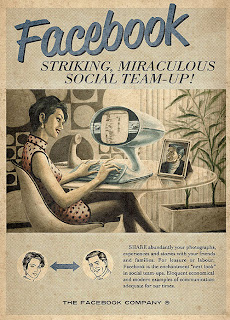
The only really frustrating thing: BuzzFeed talks about the 80's & 90's like I would about the 60's ... that's tough!

Monday, August 6, 2012

That's what the Internet in Belgium looks like ...


... according to Ruslan Enikeev, who used an association algorithm and a Google maps front end to create an interactive website that allows visitors to indicate which country they want to see the map of.


Fastcompany looks at a logical global picture, with dominance of the big players like Google and Facebook and colour coding for the countries the websites are located in.

The interesting stuff begins when you start to localize and ask for the Internet Map of Belgium. Chinese websites (yellow) seem to be pretty dominant over here. Bing is almost as big as MSN. Chinese portal Baidu is as important as Live.com. Ebay and Paypal are very much alike and can compare to Spanish, Italian or Canadian Googles, ...

In other words: making a global snapshot based on 350.000 websites and 2 mio links from 196 countries, is one thing, a local breakdown something completely different.

B.t.w: Internet maps are so Oldskool. I used to buy them in an era when having an Internet map still made sense :-)


Thursday, July 26, 2012

It doesn't always have to be an app.
A young designer from Eindhoven has created these beautiful toys to be used in hospitals to explain procedures to children. His toys contain the 4 most commonly used pieces of medical equipment: X-ray, CT-scan, ECG and an echocardiograph. Each machine has light and sound so the kids get a pretty good idea of what is going to happen to them. Now all he needs is a business angel to finance him. (copyright Hikaru Imamura, Fast Company)

Wednesday, July 25, 2012

Avinash Kaushik, the usability guru, tweets about WTPh, What the Phonics, street installations in Kopenhagen, that are attached to streetsigns to help people pronounce the streetnames.

I understand why he would find that a great idea: for foreigners all streetnames in most European cities are unpronouncable (or how pronouce Jan Van Rijswijcklaan (Antwerp), Chemin de la voierie des trèfles (Paris), Prilaz Dure Dezelica (Zagreb and I don't have special characters to make it more unreadable) or Haarlemmersdijk (amsterdam)).

So yes, it's a great idea but there's only one drawback: you have to have found the street first before you can learn how to pronounce it's name. Which doesn't solve the problem of having to look for that streetname you can't pronounce in the first place.

WTPh? - What the Phonics from Andrew Spitz on Vimeo.


Monday, July 2, 2012

The Web fought Nature and ...Nature won

Most people find it scary but I find it oddly comforting: Nature ran into the Web twice in two days and won convincingly each time. 


First there was this devastating weather in the US. They didn't call them wild storms for nothing: they left sweltering heat and massive power outages in their wake. Not only were millions of people affected, one of the casualties has been the Internet. Power interruptions at the big data center operated by Amazon.com in Virginia crashed other popular websites that rent out Amazon's computers. No Instagram, no Pinterest, no ..
how many lawyers would be pouring over SLA's and contracts right now? The Cloud being blown away by clouds: there is justice in that.


And then Nature pulled another one.


On July 1st a leap second was added to adjust global world time as close as possible to the solar time or the Coordinated Universal Time. Sensitive computer systems that run on milliseconds don't like leap seconds at all. Google was prepared but others weren't: they're not as technology geek as Google I suppose. LinkedIn, Foursquare, Stumble Upon, Gawker, ... they all went down. Mozilla 'choked on the leap second': not tech-savvy enough? 


Or, to paraphrase Forbes Business: locusts are next :-)